Robots Symmetry Drawing: A Creative and Educational Activity for Kids
Robots Symmetry Drawing is a unique and engaging activity that combines art, math, and creativity. Designed for elementary school students, this lesson plan focuses on the concept of symmetry through the fun and imaginative task of completing half-robot drawings. By drawing the second half of each robot, children not only practice their artistic skills but also develop a deeper understanding of lines of symmetry. This activity is ideal for educators looking to integrate hands-on learning into their curriculum while making math and art more accessible and enjoyable.
Understanding Symmetry in Art and Math
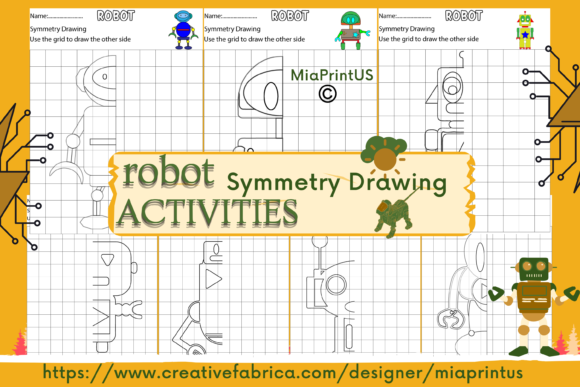
Symmetry is a fundamental concept in both mathematics and the natural world. It refers to the balance and proportion of shapes, where one half mirrors the other. In the context of Robots Symmetry Drawing, students are presented with half-robot images that they must complete by drawing the mirror image on the other side. This exercise reinforces the idea of a vertical line of symmetry, which divides an object into two identical halves.
By working on these drawings, children learn to recognize and create symmetrical patterns. This skill is essential for developing spatial awareness and understanding geometric principles. The activity also helps improve fine motor skills, as students need to carefully trace and draw lines to maintain balance and accuracy.
Features of the Robots Symmetry Drawing Lesson Plan
The Robots Symmetry Drawing worksheet includes several half-robot designs that students can complete. Each design is created on an 8.5 x 11 inch page, ensuring that there is ample space for detailed work. The high-resolution images feature thick, dark lines that make it easier for children to follow and complete the drawings. These features are especially beneficial for younger students who are still developing their pencil control and hand-eye coordination.
The worksheets are available in PDF and JPG formats, making them easy to download and print. With 7 pages included, educators have a variety of options to choose from, allowing them to tailor the activity to different skill levels and classroom needs. The unique designs are festive, fun, and exciting, capturing the attention of young learners and keeping them engaged throughout the activity.
Applications and Benefits of Robots Symmetry Drawing
Robots Symmetry Drawing is a versatile resource that can be used in various educational settings. It is particularly useful for kindergarten and early elementary classrooms, where students are just beginning to explore concepts like symmetry and geometry. The activity can also be adapted for older students who need additional practice or reinforcement of these concepts.
One of the key benefits of this activity is its ability to support multiple learning objectives. In addition to teaching symmetry, it encourages creativity, critical thinking, and problem-solving. Students must analyze the existing half of the robot and visualize how the other half should look, which enhances their cognitive development. The process of completing the drawings also promotes patience and attention to detail.
Who Can Benefit from Robots Symmetry Drawing?
This activity is suitable for a wide range of users, including teachers, parents, and homeschooling families. Educators can use it as part of a math or art lesson, while parents can incorporate it into at-home learning activities. For homeschoolers, the worksheet provides a structured and engaging way to teach symmetry and drawing skills.
Additionally, the activity is ideal for children who enjoy drawing and designing. It offers a fun and interactive way to explore symmetry, making it a valuable tool for creative learning. The completed robots can also be colored in, giving students a sense of accomplishment and providing a finished product to display or share.
Real-World Applications of Symmetry Skills
The skills developed through Robots Symmetry Drawing have real-world applications beyond the classroom. Understanding symmetry is essential in fields such as engineering, architecture, and design. For example, architects use symmetry to create balanced and aesthetically pleasing structures, while designers rely on it to produce visually appealing graphics and layouts.
In everyday life, symmetry plays a role in recognizing patterns, organizing information, and solving problems. By practicing symmetry through this activity, students build a foundation that can be applied to various academic and professional pursuits. It also helps them appreciate the beauty and order found in nature and human-made objects.
How to Use Robots Symmetry Drawing Effectively
To get the most out of Robots Symmetry Drawing, educators and parents should provide clear instructions and guidance. Start by introducing the concept of symmetry and demonstrating how to identify a line of symmetry. Then, allow students to work independently or in small groups, offering assistance as needed.
Encourage students to take their time and focus on accuracy. Remind them that the goal is to create a mirror image, not necessarily a perfect one. This approach helps reduce pressure and fosters a positive learning environment. After completing the drawings, students can color in their robots, adding a personal touch and enhancing their sense of achievement.
Conclusion
Robots Symmetry Drawing is a valuable and engaging activity that combines art, math, and creativity. It provides a fun and effective way for students to learn about symmetry while developing important skills such as fine motor control, spatial awareness, and problem-solving. With its high-quality designs and practical features, this worksheet is an excellent resource for educators and parents alike.
Whether used in the classroom or at home, Robots Symmetry Drawing offers a meaningful and enjoyable learning experience. By exploring symmetry through the lens of robotics, students gain a deeper appreciation for the interconnectedness of art and mathematics. This activity not only enhances their understanding of symmetry but also sparks their imagination and creativity, making it a valuable addition to any educational toolkit.